|
|
|
|
|
|
|
|
|
American Art Postcards
America-Art-Prints  Postcards Postcards |
| Navigation | |
| Page 4 of 9 | Previous .. Page 4 .. Next |
|
|
|
|
|
|
|
|
|
|
|
|
|
|
|
|
|
|
|
|
|
| Navigation | |
| Page 4 of 9 | Previous .. Page 4 .. Next |
| Text for the above items : |
LCT 312 by Ivan Berryman. (PC) LCT (Landing Craft Tank) 312 is shown unloading a Sherman tank directly onto the beach during the Normandy landings of June 1944. Over 1,000 of these versatile craft were built in the United States, with a small number being constructed in the UK and Canada. |
Midway - The Setting Sun by Ivan Berryman. (PC) Depicting Dauntless and Devastator attacking the Japanese aircraft carrier Akagi during the Battle of Midway. |
Red Tails by Ivan Berryman. (PC) Often described as the most effective fighter escorts in the US Army Air Force, the famous red-tailed Tuskegee airmen could proudly boast that they never lost a single bomber to enemy fighters in all the missions flown. Nearest aircraft here is the P51C of Lt. Lee A Archer Jr, who finished the war with four confirmed victories and one shared. His personal aircraft was named Ina the Macon Belle after his wife. |
The Battered Band by David Pentland. (PC) Bastogne, Ardennes, Belgium, 24th December 1944. Surviving U.S. tank crew from Task Force Cherry and Paratroopers of 101st Airborne Division take a break while awaiting orders for their next battle. |
Battle of the Copeland Islands by David Pentland (PC) USCS Ranger captained by John Paul Jones attacks and defeats HMS Drake off the Copeland Islands at the mouth of Belfast Lough. This was the first battle of the newly formed American Continental Navy. |
Crockett's Last Sunrise, at the Battle of the Alamo by Mark Churms (PC) Crocket is shown at the Barricades at 6am on the 5th March 1836. The siege of the Alamo ended on March 6th, when the Mexican army attacked while the Alamo defenders were sleeping. The garrison defenders awakened, and the final fight began. One of the women who were gathered in the chapel witnessed Crockett running to his post, Crockett paused briefly in the chapel to pray. But when the Mexican soldiers breached the outer walls of the Alamo complex, most of Crocket and the defending Texians fell back to the barracks and the chapel area which had been the plan. Davy Crockett and his men were too far from the barracks to be able to take shelter and were the last remaining defenders within the mission to be in the open. The men desperatly defended the low wall in front of the church, using their rifles as clubs and using there knives in close combat as the Mexican troops were too close and made it impossible to reload their rifles. After a volley of fire and a charge with fixed bayonets, Mexican soldiers pushed the few remaining Texans back toward the church and soon after the Battle for the Alamo had ended after lasting 90 minutes. It is said that the body of Crockett was surrounded by up to 12 Mexican soldiers bodies and one with Crocketts knife in him. |
Market Garden. Arnhem by Graeme Lothian. (PC) Paratroopers of the 1st Battalion sort their kit out and get ready to enplane the waiting American Dakota C-47s of the 14 and 59 Squadrons/61st Troop Carrier Group. The paratroops took off simultaneously from Saltby and Barkston, commencing at 1121. All planes were in the air by 1155. A relatively uneventful trip over the northern route to the Netherlands resulted in not a plane being shot down; only five were slightly damaged. The 1st Battalion were dropped at 1403, 2nd Battalion at 1353 and the 3rd Battalion at 1356, all at DZ-X, west of Wolfhezen some eight miles west of Arnhem. The Battalion orders were for three different routes to the Arnhem Bridge. 1st Battalion took the Leopard route, 2nd Battalion Tiger route and the 3rd Battalion Lion route. Only the 2nd Battalion, commanded by Lt colonel John Frost managed to fight their way to the bridge. |
Kearsarge Sinking The Alabama - June 19th, 1864 by Henry Alexander Ogden (PC) The USS Kearsarge sank the CSS Alabama on June 19, 1864, off the coast of Cherbourg, France, during a fierce naval battle in which the Kearsarges superior firepower proved decisive. This victory marked a significant blow to the Confederate naval campaign and helped diminish the effectiveness of Confederate commerce raiders. |
Night Drive to Manhay, Barkmann in the Ardennes, 24th December 1944 by David Pentland. (PC) Oberscharfuhrer Ernst Barkmann in Panther 401 accidentally found himself as the spearhead of the 2nd SS Panzer Divisions night assault on the crossroads at Manhay. Initially mistaking a lone Sherman of US 7th Armoured Division as that of his own commander, he pulled alongside the enemy tank, and only realised his mistake when he noticed its unusual red interior lights. In a brief close quarter fight he managed to destroy the M4 with the Panthers anti-personnel mortar (Panzergranate) He then proceeded along the moonlit forest roads past a succession of surprised American units to Manhay and on towards Liege, having left several destroyed vehicles in his wake. His appearance caused havoc in the US defences, culminating in a rout. |
The Defence of Napoli by Ivan Berryman. (PC) The Spring of 1943 saw intense bombing raids on the Italian port city of Naples by American B.24s and the Italian pilots responded with spirited attacks on the Liberators, flying from their nearby base of Capodichino. Just entering service with 22° Gruppo was the new Reggiane Re.2005 fighter, one of which can be seen here rolling away after a head-on attack on the bomber formation. A 22° Gruppo Macchi 202 has just damaged a B.24 in the distance. |
Pacific Warriors by Ivan Berryman. (PC) Often sidelined by other, more glamorous fighters, the Vought F4U Corsair is considered by many to be the best piston-engined fighter ever built, able to outfly anything the Japanese air force could pit against it. So perfect was this versatile and robust design that it remained in production for 12 years, right up until 1952. The most important operator of the F4U during the Second World War was the US Marine Corps, flying from scattered island bases throughout the Pacific, these examples being from the 4th Marine Air Wing based at Majuro Atoll in the Marshalls during the Summer of 1944. |
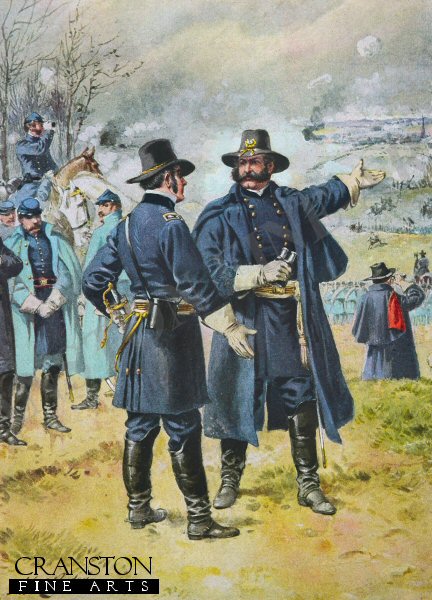
Burnside at Fredericksburg - December 13th, 1862 by Henry Alexander Ogden (PC) The Battle of Fredericksburg, fought from December 11th to 15th, 1862 was a significant skirmish in the Civil War. Union General Ambrose Burnside faced Confederate General Robert E. Lee. Burnsides plan involved a direct assault on Lee’s entrenched positions along Maryes Heights, but his forces encountered fierce resistance and suffered heavy casualties. The battle resulted in a devastating defeat for the Union, with Burnsides leadership and tactics heavily criticized which would lead to his eventual replacement. |
USS Ranger by Ivan Berryman. (PC) Two F14 Tomcats of VF-1 pass in close formation over the stern of the veteran USS Ranger (CV-61) |
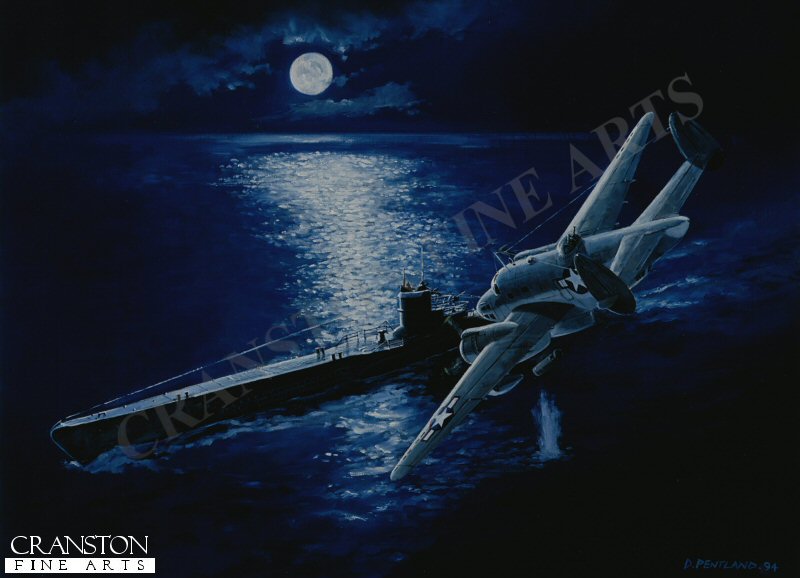
The Hunt for U-Boat 134 by David Pentland. (PC) Lockheed Vega PV-1 VB32 Squadron in the Santaren Channel. From this point on the U-boat was hunted and harassed only to be sunk in the Bay of Biscay. |
The Bombardment of Tripoli, 1804 by Ivan Berryman. (PC) Ships of Commodore Preble's Mediterranean Squadron are shown during the action of 3rd August 1804 when they provided support to the gunboats and mortar boats as they pounded the defensive walls and xebecs that were defending Tripoli. In the left foreground, the bomb boat Robinson rolls as she fires her mortar whilst the brig Argus takes up station behind Constitution, both of which are firing broadsides. The brig Syren is in the far distance, engaging more of the Tripolitan xebec gunboats, having cut inside of Constitution to engage the enemy more closely. |
Pure Dynamite by Ivan Berryman. (PC) Crucial to the early stages of Operation Overlord on 6th June 1944, the B-26 Marauders of the 386th Bomb Group, 553rd Bomb Squadron, carried out low level bombing runs on the German defenses to pave the way for the Allied landings along the beaches of northern France and thereafter provided vital air support as the invasion gathered momentum. 131576 AN-Z, now on display at the Utah Beach Museum, is depicted here as a tribute to the brave crews of the 386th. |
Edward Rickenbacker by Ivan Berryman. (PC) Captain Edward Rickenbacker of the 94th Sqn, United States Air Force, is shown in his Spad S.XIII, pursuing a Fokker D.VII. Eddie scored his first victory on 29th April 1918, but by the November Armistice he had increased his tally to 26 confirmed kills. |
Men of the United States Navy During the Battle of Lake Erie 1813 by Chris Collingwood. (PC) No text for this item |
Gunline Omaha - USS Texas by Randall Wilson (PC) In support of the American landings at Utah and Omaha beaches, the USS Texas slugs it out with German heavy gun emplacements during the D-Day landings. |
8th US Infantry, 4th US Division enter Sainte-Marie-du-Mont by Jason Askew. (PC) After breaking through the German defences on Utah Beach, and neutralising the enemy strongpoint at La Madeleine, forward recon elements of the 8th US Infantry, 4th US Division, enter the town of Sainte-Marie-du-Mont, Normandy, in order to effect a link up between themselves and the paratroopers of the 101st Screaming Eagles. |
Into the Unknown by Ivan Berryman. (PC) Douglas C-47s of the 91st Troop Carrier Squadron, 439th Troop Carrier Group deploy the 101st Airborne Division above the drop zone on the night of 5th/6th June 1944 at the start of Operation Overlord. |
|
Contact Details |
|
Sign Up To Our Newsletter!
This website is owned by Cranston Fine Arts. Torwood House, Torwoodhill Road, Rhu, Helensburgh, Scotland, G848LE Contact: Tel: (+44) (0) 1436 820269. Email: cranstonorders -at- outlook.com
|
 |