|
|
|
|
|
|
|
|
|
American Art Postcards
America-Art-Prints  Postcards Postcards |
| Navigation | |
| Page 3 of 9 | Previous .. Page 3 .. Next |
|
|
|
|
|
|
|
|
|
|
|
|
|
|
|
|
|
|
|
|
|
| Navigation | |
| Page 3 of 9 | Previous .. Page 3 .. Next |
| Text for the above items : |
Dogfight over Asch, Belgium, 09.20 a.m., New Years Day, 1st January 1945 by David Pentland. (PC) As the four P51D Mustangs of Major William T Haltons Yellow Flight, 487th Fighter Squadron took off from Asch, they found themselves in the middle of a massive German attack. That New Years Day the Luftwaffe had launched hundreds of aircraft in low level raids against the allied airfields across Northern France and Belgium. The unexpected take-off by the 487th however, ended Jagdgeswader 11s chances of success, with Yellow Flight alone claiming 9 enemy aircraft destroyed. |
Red Beach Two, Tarawa Atoll, 20th November 1943 by David Pentland (PC) US Marines of the 2nd Battalion, 2nd RCT, 2nd Marine Division, supported by LVTs and tanks, take part in the successful but bloody assault on Betio Island, part of the Tarawa Atoll. Operation Galvanic as it was known became the first step on the island road to Japan itself. |
USS Coral Sea by Ivan Berryman. (PC) USS Coral Sea (CV-43 being replenished by fast combat support ship USS Seattle (DE-3) as two of the carriers compliment of F.4s of VF-111 The Sundowners makes a low pass. |
Battle of the Ironclads by Ivan Berryman. (PC) At Dawn on 9th March 1862, as the American Civil War raged on, an extraordinary combat took place in Hampton Roads, a naval exchange that was to herald a new age and completely change the concept and design of modern warships. Having already destroyed the two Federal warships Cumberland and Congress the previous day, the Confederate ironclad CSS Virginia readied herself for another day's work, her target this time being the grounded Minnesota. As the Virginia approached her target, she was confronted by the much smaller Union ironclad Monitor which had just arrived after a fraught journey from New York. Thus began an exchange of fire that lasted more than three hours, each ship's shot merely bouncing and deflecting off its opponent without inflicting any serious damage. With her smokestack shot away, the Virginia now concentrated her shot on the Monitor's tiny wheelhouse where a direct hit blinded the Union ship's commander, necessitating a temporary withdrawal. By the time Monitor was ready to re-engage, the Virginia was limping away, the result of this fierce encounter being nothing more than stalemate. Neither ship could claim any form of victory and neither had sustained any meaningful damage. Though clumsy and difficult to handle, the thick iron plating and low profiles of these very different vessels signaled a direction in warship design that lasted until the Second World War, eighty years later. |
Baptism of Fire - St Mihiel Salient, 12th - 15th September 1918 by David Pentland. (PC) Renault FT 17 baby tanks of the recently formed US 304th tank brigade commanded by the young Lt. Col George S. Patton Jnr. are employed for the first time during the allied assault on the St Mihiel Salient. Leading the 344th battalion in person Patton and his tanks help the infantry divisions push the enemy back to the Hindenberg line in only 4 days. |
The Flight by Frederic Remington. (PC) Native American tribes posed a significant threat to American frontiersmen through their resistance to encroachment on their lands. As settlers moved westward, tribes defended their territories with a combination of strategic warfare, guerrilla tactics, and alliances with other tribes. These confrontations often involved raids, ambushes, and coordinated attacks designed to protect their homelands and disrupt settler expansion. |
Escort for the Troops - USS New York by Anthony Saunders. (PC) The Atlantic ocean was the lifeline between Britain and America, as well as millions of tons of raw materials, GIs were also transported over in all manor of hastily converted liners. Protecting the troops from marauding u-boats and German surface ships was of paramount importance to the allied fleets. Although USS New York spent a good deal of the war in the Atlantic, she also participated in the Torch landings off North Africa and took part in the Pacific campaign, seeing action at both Iwo Jima and Okinowa. |
USS United States by Ivan Berryman. (PC) Still showing some signs of her encounter with HMS Macedonian on 25th October 1812 and under the command of Captain Stephen Decatur, USS United States is shown surging through a heavy Atlantic swell en route for Newport, Rhode Island, which she would eventually reach on 4th December, in company with the Macedonian, who she had so decisively defeated and taken as a prize. |
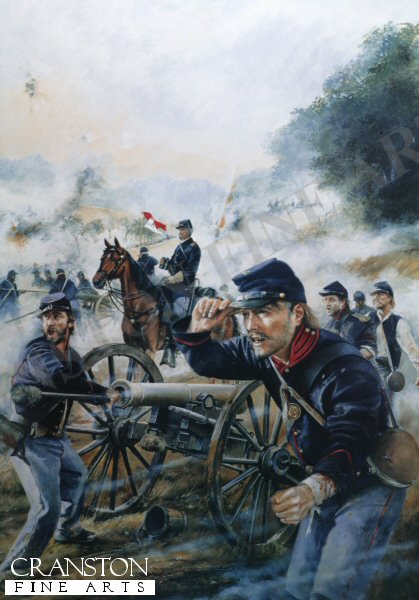
Union Artillery at the Battle of Malvern Hill., July 1862 by Chris Collingwood. (PC) On July 1st 1862 in Henrico County Virginia, the battle of Malvern Hill, also known as the Battle of Poindexters Farm, took place, The battle of Malvern Hill was last of six battles fought in seven days wich are known as the Seven Day battles of the Peninsula Campaign. Gen.Robert E Lee launched a series of assaults on the nearly impregnable Union troop position on Malvern Hill. The Confederate forces suffered more than 5,300 casualties without any success. Although the Union forces had won, Major George B McClellan withdrew from his strong position to entrench his army at Harrison Landing on the James River where the Union troops would be protected from the sea by Union Gunboats. |
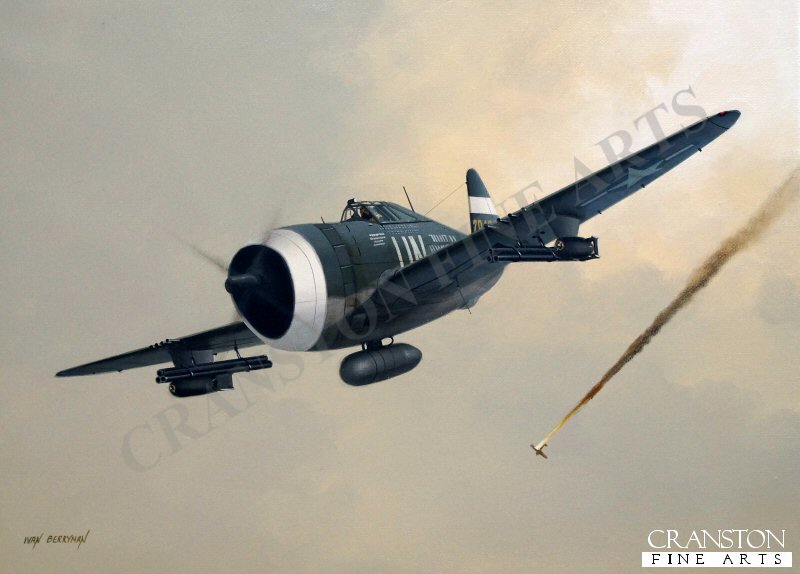
Tribute to Walker 'Bud' Mahurin by Ivan Berryman. (PC) Flying P-47 Thunderbolts with the 56th Fighter Group in England, Bud Mahurin scored more than 20 victories during World War Two. Seen here in his personal aircraft 42-8487 UN-M named The Spirit of Atlantic City owing to it being paid for by bonds from that city, he shot down three Me109s in a day and three Fw190s another day, before eventually being brought down by return fire from a German bomber. Evacuated from France with the help of the Resistance, he then flew P-51 Mustangs against the Japanese in the Philippines, scoring one more victory before again being shot down, bailing into the ocean. He went on to score more victories in the Korean War before being shot down and taken prisoner for more than a year. He was the only pilot of the US Air Force to down enemy aircraft in the European Theater, Pacific Theater and Korean War. He died in 2010. |
Tribute to Pappy Boyington by Ivan Berryman. (PC) Pappy Boyington bringing his Vought F4U-1A Bu No 17883 of VMF-214 in to land at Turtle Bay Airfield, Espiritu Santo, New Hebrides Islands, in December 1943. Although often depicted in another aircraft, Boyington flew 883 more than any other of his Corsairs. |
The Aircraft That Found the Bismarck by Ivan Berryman. (PC) In early May 1941, in conditions of strict secrecy because the United States was not yet at war, seventeen pilots of the US Navy had arrived in Britain and been attached to Catalina squadrons of Coastal Command. These experienced PBY pilots were there to assist the Royal Air Force to become familiar with the Catalina, and also to gain operational experience for the US Navy. On 26th May 1941 Catalina Z of No.209 Sqn, commanded by Flying Officer Dennis Briggs RAF, with Ensign Leonard B Smith USN as co-pilot, joined the search for the Bismarck. At 1015 the aircraft was being flown in poor visibility at an altitude of 500ft when Ensign Smith sighted the Bismarck at a range of eight miles. The Catalina was flown towards the contact so that a positive identification could be made and emerged from the cloud only 500 yards from the German ship. The aircraft met a hail of anti-aircraft fire but was able to make its escape. As a result of the sighting report from Catalina Z the Bismarck was again engaged by ships and aircraft of the Royal Navy and was sunk at 1040 on 27th May 1941. Leonard Smith can be considered therefore, the first American to be directly involved in action in World War Two. He was awarded the Distinguished Flying Cross (American) for his actions. |
Drop Zone Ahead by Ivan Berryman. (PC) Douglas C-47s of the 439th Troop Carrier Group, 94th Troop Carrier Squadron, approach the Drop Zone above Normandy on the night of 5th / 6th June 1944 at the start of Operation Overlord. |
The Iron Brigade, 2nd Wisconsin Volunteer Infantry Regiment, Brawner's Farm, August 1862 by Chris Collingwood (PC) The Iron Brigade initially consisted of the 2nd, 6th, and 7th Wisconsin Volunteer Infantry Regiments, the 19th Indiana, Battery B of the 4th U.S. Light Artillery, and was later joined by the 24th Michigan. This particular composition of men, from the three Western states, led it to be sometimes referred to as the 'Iron Brigade of the West'. They were known, throughout the war, as the 'Black Hats', because of the black, 1858 model Hardee hats issued to Army regulars, rather than the blue kepis worn by most other Union Army units. Battle of Second Manassas, Brawner's Farm, August 28, 1862. In order to draw Pope's army into battle, Jackson ordered an attack on a Federal column that was passing across his front on the Warrenton Turnpike on August 28. In a fierce firefight in which the opposing lines were scarcely 100 yards apart, Jackson's men locked horns with the Midwesterners of Brig. Gen. John Gibbon's Black Hat Brigade, known thereafter as the Iron Brigade. The fight at the Brawner Farm lasted several hours and resulted in a stalemate. Convinced that he had trapped Jackson. Pope concentrated the bulk of his army against him. On August 29th, Pope launched a series of assaults against Jackson's position along an unfinished railroad grade. The attacks were repulsed with heavy casualties on both sides. At noon, Longstreet arrived on the field from Thoroughfare Gap and took position on Jackson's right flank. On August 30th, Pope renewed his attacks, seemingly unaware that Longstreet was on the field. When massed Confederate artillery devastated a Union assault by Fitz John Porter's command, Longstreet's wing of 28,000 men counterattacked in the largest, simultaneous mass assault of the war. The Union left flank was crushed and the army driven back to Bull Run. Only an effective Union rearguard action prevented a replay of the First Manassas disaster. Pope's retreat to Centreville was precipitous, nonetheless. The next day, Lee ordered his army in pursuit. This was the decisive battle of the Northern Virginia Campaign. |
USS New Jersey, batten down the Hatches by Randall Wilson. (PC) USS New Jersey seen battling her way through a Hurricane in 1944. |
Dawn Chorus - Tribute to the men of the 553rd Bomb Squadron, 386th Bomb Group by Ivan Berryman. (PC) Martin B.26 Marauders of the 553rd Bomb Squadron, 386th Bomb Group are depicted approaching the Normandy coast early on 6th June 1944. These aircraft were among the first to bomb the enemy gun emplacements and reinforcements situated along the beaches in order to help clear the way for the Allied landings that were just hours away at the start of Operation Overlord. These B.26s carried out low level bombing sorties over Utah Beach, their low altitude being the key to their high level of success and accuracy. Nearest aircraft is 131576 AN-Z 'Dinah Might' now on display at the Utah Beach Museum. |
Well Earned Rest by Jason Askew. (PC) After taking the town of Sainte-Marie-du-Mont, US infantry take time out for coffee and cigarettes while keeping a look out from the rooftop of the building they have captured. |
Guadalcanal by David Pentland (PC) Solomon Islands, August 1942 - February 1943. M2A4 and M3 tanks of A Company, 1st US Marine Tank Battalion. move out from Henderson Field to support the perimeter from Japanese attacks. |
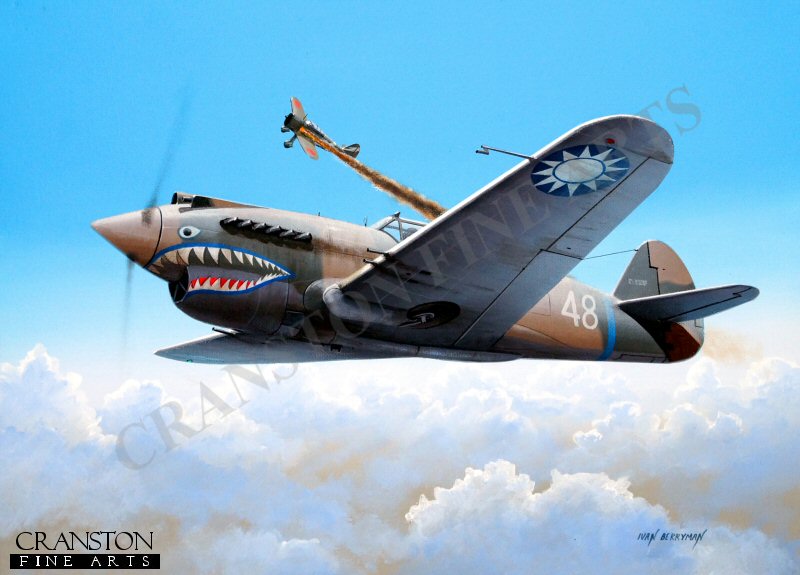
Tribute to David Lee 'Tex' Hill by Ivan Berryman. (PC) One of America's best known Aces, 'Tex' Hill scored his first victories in 1942 with the American Volunteer Group (AVG) known as the Flying Tigers. In his P-40 Warhawk, he was credited with 12 and a quarter victories while flying in aid of the Chinese against the Japanese, including the Ki.27 'Nate' depicted here. After the AVG was disbanded, he scored 6 more victories flying P-51 Mustangs with the USAAF. Tex Hill died in 2007 aged 92. |
USS North Carolina ,Saipan Bound by Anthony Saunders. (PC) By June 1944 the US Fleet had made a huge leap across the Pacific to the Marianas, a small group of Japanese held islands of which Saipan would prove the most difficult to overcome. The landing were supported by the US 5th Fleet, which included USS North Carolina together with an increasingly powerful armada of battle hardened warships. |
Through the Hands of Victory, Baghdad, Iraq, 7th April 2003 by David Pentland. (PC) Abram M1A1 tanks and Bradley APCs of Charlie Company, the Cobras, 1-64 Desert Rogues Armoured Battalion, US 3rd Infantry Division (Mechanised) drive into central Baghdad, through Saddams famous war memorial. |
|
Contact Details |
|
Sign Up To Our Newsletter!
This website is owned by Cranston Fine Arts. Torwood House, Torwoodhill Road, Rhu, Helensburgh, Scotland, G848LE Contact: Tel: (+44) (0) 1436 820269. Email: cranstonorders -at- outlook.com
|
 |